


Key points
- Contractual relationships count as a conflict of interest
- Real patients can review their own order
- Partners shouldn't solicit reviews of your pharmacy
- Never trade reviews with a partner
- Reply without confirming anyone is a patient
No. A telehealth company that sends you prescriptions has a business relationship with you, and Google's review rules treat that as a conflict of interest. Its staff shouldn't review you, and you shouldn't review them. Its patients who actually received medication from you are a different matter: they're your customers too, and their honest compounding pharmacy Google reviews are allowed.
The trouble starts when the partnership leaks into the review profile. I'll explain where the line sits, how to clean up a profile that's already been muddied, and how to ask for reviews without crossing it.
Why partner reviews break Google's conflict of interest rule
Google's Maps content policy on reviews and conflicts of interest lists conflict of interest as a violation, and it spells out that a conflict can include current or former employment or "a contractual or consultory relationship." A telehealth company, a prescriber group or a marketing affiliate that sends you work fits that description exactly. So does anyone on your own staff.
It matters more for compounding than for a corner pharmacy, because patients vet a compounder through its reviews before they order. In a patient forum thread comparing compounding pharmacies, reading reviews is how people decide who to trust. And in a patient discussion about compounding pharmacy reviews filled with partner promotion, patients noticed pharmacy review profiles full of posts that read like ads for the telehealth brand behind them. Once patients spot that, they stop believing any of your reviews, the honest ones included.
Who can and can't review your compounding pharmacy
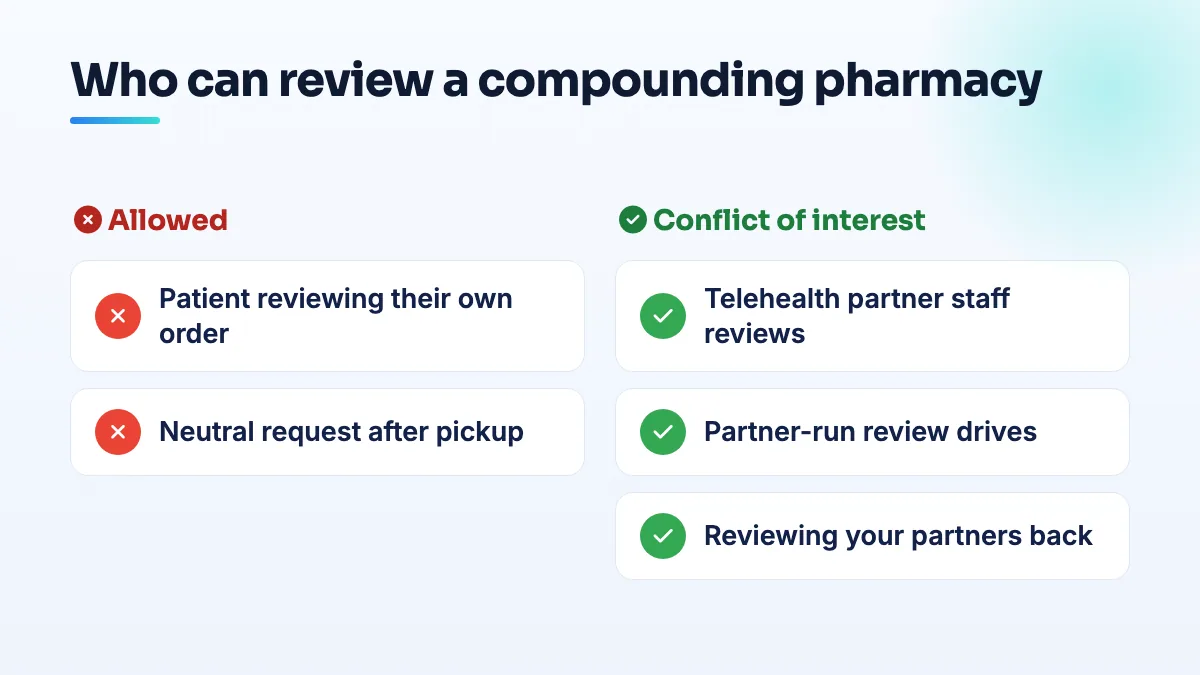
- Allowed: a patient who received a prescription you filled, whoever prescribed it, writing about their own experience with you.
- Not allowed: staff, owners or contractors of a telehealth company, clinic or affiliate that sends you prescriptions.
- Not allowed: your own employees, including reviews of the pharmacy they work at.
- Not allowed: you reviewing your partners, or trading reviews with them.
- A risk even when the reviewer is real: a partner asking its patients to review you as part of its own marketing, especially with a discount, a code or a script.
How to clean up your compounding pharmacy Google reviews
- Read the last year of reviews with your partner list beside you. Mark any that were written by partner staff, that name a partner's brand, promo code or pricing, or that arrived in a burst right after a partner launched. Those are the ones that make the profile look bought.
- Tell every partner in writing not to review you or ask for reviews of you. Put it in the agreement if you can. A short email is better than nothing. Ask them to remove any review scripts or links to your profile from their patient emails.
- Flag the reviews that break the policy. Use the report option on each review in Google Maps and pick the reason closest to a conflict of interest. Reviews by a partner's staff are the clearest case. A real patient praising the telehealth brand usually stays up; reply to it instead.
- Ask your own patients directly, the same way for everyone. After pickup or delivery, send one short, neutral request with your review link. No discount, no gift, no asking only the happy ones.
- Reply without confirming anyone is a patient. Thank the reviewer, talk about your process in general terms, and never mention a medication, a dose or a prescriber. The federal health regulator has settled with a dental practice over review replies that disclosed patient information, as shown in the HHS resolution agreement with New Vision Dental. A pharmacy is held to the same privacy law.
If a partner won't stop, I'd treat that as a reason to rethink the partnership. You can't control what another company posts, but you can decide whose prescriptions you fill.
Edge cases pharmacists ask about
A real patient's review is really about the telehealth company
Complaints about the consultation, the doctor or the subscription price are real experiences, and Google won't remove them just because you weren't the cause. Reply briefly: you fill the prescription, the prescriber handles the consultation and the plan, and here's how to reach your team about anything you control.
The partner is owned by the same people as the pharmacy
Then the conflict is even clearer. Nobody at either business should review the other.
A former employee left a review
Former employment is named in the same policy. I cover how to report a Google review from a former employee in a separate answer.
Patients ask where to leave a review
Give them your own link, and keep it on your compounding page too. I explain what else belongs on the compounding pharmacy page patients read before ordering.
Keeping the profile clean over time
Reviews are only one part of how a compounder earns trust, and they're usually the part that needs cleaning first. Keeping them honest, replying safely and building the pages behind them is the core of our SEO for pharmacies, and the profile side sits inside Google Business Profile management.
People also ask
Can an agency's restricted Google account get my profile suspended?
Yes. If an agency, freelancer or vendor with access to your listing has its Google account restricted, Google can suspend every profile connected to that account, and yours goes with it. The notice says a Google account associated with the profile was restricted. Proving your address won't fix it: remove the account, have the agency resolve its restriction, and appeal on that point.
Read the full answer: Can an agency's restricted Google account get my profile suspended? →
Can you appeal a Google review decision more than once?
No. You get one appeal on each review Google decides not to remove, and once the appeal is denied, that decision is final for that review. Wait for the first decision before appealing, and only appeal with new evidence tied to a specific policy clause. After that, your options are a calm public reply, reporting new reviews from the same accounts, and outnumbering the review with genuine ones.
Read the full answer: Can you appeal a Google review decision more than once? →
How do you ask a B2B buyer for a Google review?
Ask one named person who saw the job go well, such as the engineer whose first article passed or the manager who watched your sign go up, within a day or two of the job. Ask in person first, then send a short email with your direct review link. Tell them they don't need to mention part numbers or their company, and never offer anything in return.
Read the full answer: How do you ask a B2B buyer for a Google review? →
Can a booth renter get their own Google Business Profile?
Usually not at the salon's address. Google only lets a business in a shared space list that address if it has its own dedicated space with permanent signage, where customers deal with its own staff during business hours. An open-floor chair doesn't pass that test. A private suite with your name on the door can, and a renter who also travels to clients can list as a service-area business with the home address hidden.
Read the full answer: Can a booth renter get their own Google Business Profile? →
Why doesn't my business show up when people search its exact name?
Usually because Google either can't tie your profile to your business as a clear entity, or it has confused you with another business with a similar name and sometimes merged the two. Open your profile's share link on a signed-out phone: if it opens your profile, strengthen your name, phone and website signals; if it opens another business, it's a data problem to escalate with proof.
Read the full answer: Why doesn't my business show up when people search its exact name? →