

An independent pharmacy can't outrank a chain on "pharmacy near me" by writing more about being friendly. Where you can win is the services chains barely explain online: compounding, vaccines, medication reviews, blister packs, long-term care and delivery. The answer is one proper page for each service you really offer, written for the person deciding whether to trust you with it.
This matters most for compounding. Patients vet a compounding pharmacy through its Google reviews and website before they send a prescription, so thin pharmacy service pages lose you the order at the exact moment someone is checking you out.
Below is the page list I'd build, what goes on each page, the order I'd write them in, and the mistakes that get pharmacies suspended or stuck.
Why pharmacy service pages are where an independent can win
Chain pharmacies own the generic searches. They have the locations, the hours and the brand, and their own staff will tell you that's what drives most choices. In a Reddit thread where chain pharmacy staff discuss what patients choose on, the view was that stars matter less than location and hours. I agree for a plain refill. Nobody drives past three pharmacies for one.
It's different when the service is specialized. A chain's website usually has one page listing everything it does, written once for the whole country. Its local reviews are near-identical from store to store and are about wait times, staffing and rudeness, not about the service a patient is researching. Chain store staff on Reddit talking about their one-star reviews describe exactly that pattern.
An independent that offers compounding or adherence packaging has something the chain can't show well: a named pharmacist, a local process and reviews that mention the service. The page is where you put that in front of the patient.
The compounding case is the clearest. In a patient forum thread about choosing a compounding pharmacy, patients compare pharmacies by reading their reviews before ordering. They're checking whether you're real, whether you're careful and whether other patients got what they paid for. If your website has one line that says "we compound," you've given them nothing to check.
The pages to build, and who reads each one
Only build a page for a service you actually provide and want more of. Six pages done properly beat twenty thin ones.
| Page | Who is reading it | What it must answer |
|---|---|---|
| Compounding | Patients, and prescribers checking you out | What you compound and don't, how a prescription reaches you, turnaround, shipping or pickup, cost basics |
| Vaccines | Adults, parents, employers | Which vaccines, walk-in or booked, insurance, age limits, what to bring |
| Medication reviews | Patients on several medicines, their families | What happens in the review, how long it takes, who qualifies, what they leave with |
| Blister packs and adherence packaging | Adult children of older patients | How packs are filled and checked, refill syncing, changes mid-cycle, delivery |
| Long-term care | Group homes, assisted living and facility staff | Which facilities you serve, delivery times, emergency supply, how you handle orders |
| Delivery and prescription transfer | Anyone switching from a chain | Delivery area and days, curbside, how to transfer in two minutes |
The delivery and transfer page is the one that ties into your map listing, because hours, delivery and curbside are the details people check on the profile. I cover those fields in the guide to your pharmacy Google Business Profile.
How to write each page, step by step
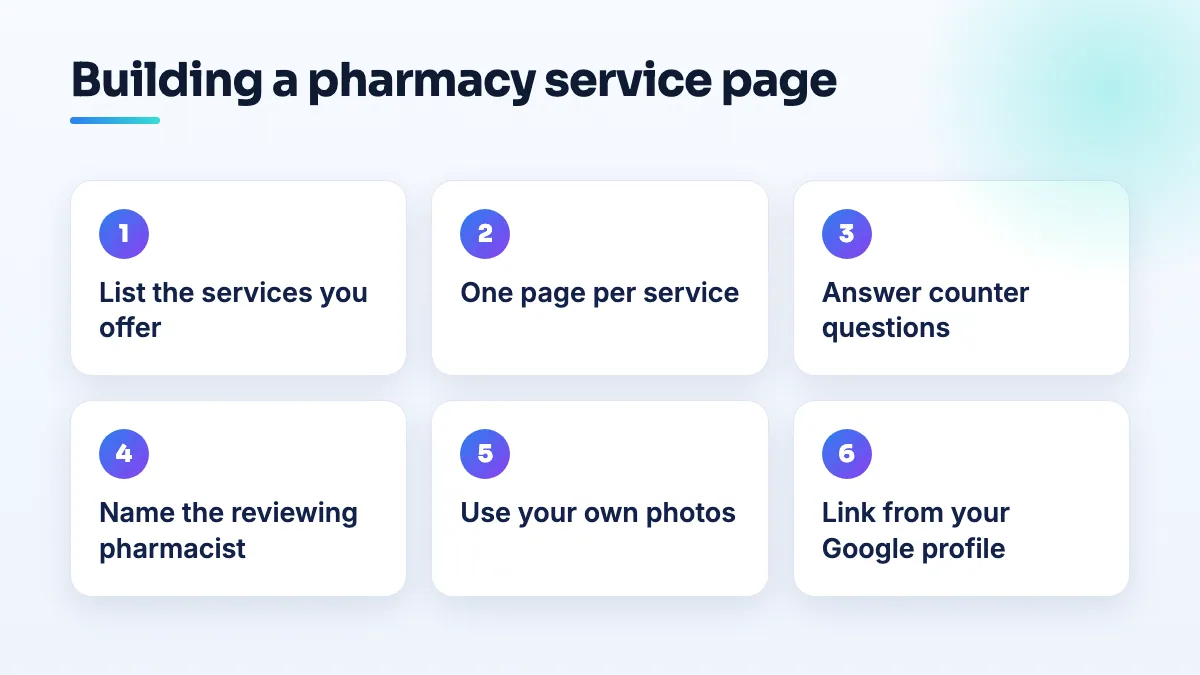
- List what you do now, with rough monthly volume. Sit down with your pharmacist in charge and write each service, how often you do it and whether you want more of it. That list decides which pages exist. If you stopped offering a vaccine clinic, it doesn't get a page.
- Give every service its own URL. One page for compounding, one for blister packs, one for long-term care, and so on. Use the name patients use in the page title ("blister packs" as well as "adherence packaging") and put the plain version in the first sentence.
- Answer the questions your counter staff hear every week. Ask them. Price range or how pricing works, insurance, turnaround, what the patient needs to bring or send, and what happens if something goes wrong. Write those answers as short sections with plain headings. This is what a patient reading your reviews wants confirmed.
- Put a named pharmacist on each page. Add a short line saying which pharmacist wrote or checked the page, with their role. Google's guidance on creating helpful, reliable content asks who created content and puts more weight on trust for health topics. It doesn't demand a particular credential, but a real pharmacist's name is the most honest answer to that question you can give.
- Use your own photos. The compounding area, a filled blister pack with the label blurred, the delivery car. Stock photos of smiling pharmacists tell a careful patient nothing.
- Link each page from your Google profile and your homepage. Add the services to the profile's services list and use the pages as the links where the profile allows it. Put a clear call and transfer option at the top of each page, not only at the bottom.
- Review every page twice a year. Services, insurers and prices change. A page that promises a flu clinic in March is worse than no page.
If writing six pages sounds like a month of evenings, this is the kind of service page writing we do with the pharmacist, not instead of them. The facts have to come from you.
The compounding page: written for patients who read reviews first
Your compounding pharmacy page does a different job from the others. The patient has often already been sent your name by a prescriber, and they're deciding whether to trust you. Here's what I put on it:
- What you compound, and what you don't. Dosage forms, the kinds of preparations you make, and a plain line about what you won't do. Saying no to something makes the rest more believable.
- How the prescription reaches you. Prescriber sends it, patient transfers it, or both. Say what the patient has to do and how long until they hear from you.
- Turnaround and delivery. Where you can ship and where you can't, if that applies to you, and how long a typical order takes.
- A link to your Google reviews. Patients are going to read them anyway. Send them there yourself, and make sure the reviews and the page tell the same story.
- A named contact. A phone number that reaches the compounding team, not a general line.
Replying to reviews is part of the same job. Pharmacists in a Reddit thread where pharmacists read their own reviews say they wish they could answer them. At an independent you can. Keep replies general, never confirm that someone is a patient, and never mention a medication or a diagnosis. The rules on healthcare Google review responses apply to you just as they do to a clinic.
If you fill prescriptions for telehealth companies, keep their promotion off your review profile. Partner-written praise is the fastest way to make an honest compounding profile look bought.
Blister packs and long-term care: pages for the caregiver
The person searching for a blister pack service is rarely the patient. It's usually a son or daughter worried that a parent is missing doses, or a care home manager who needs a pharmacy that delivers on time. Write for them.
- Show the pack. One clear photo of a filled pack and a sentence on how it's checked before it leaves.
- Explain what happens when a doctor changes a dose mid-month. That's the question every caregiver has and almost no page answers.
- Say how refills are synced so the family isn't making five trips.
- On the long-term care page, list the kinds of facilities you serve, your delivery windows, and how staff reach a pharmacist after hours.
These are the searches where a local independent should be the obvious answer. A national chain page can't tell a family which day the delivery van comes.
What not to do
- Don't add services to your business name on Google. In a Help Community thread about a pharmacy suspended after a name edit, a fully licensed pharmacy was suspended for "deceptive content" after changing only the format of its name, and the appeal sat under review for two weeks. Services belong on your pages and in the profile's services list, never in the name.
- Don't advertise the pages before checking the ads rules. Google's healthcare and medicines ads policy requires US pharmacies to hold LegitScript or NABP certification before running pharmacy ads. I explain the gates in the post on pharmacy Google Ads, LegitScript and NABP. Organic pages don't need it; ads do.
- Don't copy manufacturer or wholesaler text. It's on a thousand other sites and says nothing about you.
- Don't make a page per town with the city name swapped. One strong page per service, with your delivery area written into it, is enough.
- Don't promise outcomes. Describe the service and the process. Leave treatment claims to the prescriber.
Questions pharmacists ask me
Should the pages live on our site or on the buying group's template site?
Your own domain if you have the choice. Template sites often share the same text across hundreds of pharmacies, and you can rarely add pages. If you're stuck with one, ask whether you can add custom pages per service.
Who should write them?
The pharmacist supplies the facts and checks the final version. Someone else can do the writing. What matters is that a named pharmacist stands behind it, which is what Google's guidance on health content is really asking about. I've gone through that in more detail in the post on who should author health content under Google's E-E-A-T guidance.
How long before these pages bring calls?
I won't give you a number I can't back up. It depends on your market and your competitors. What I can say is that a service page can only rank if it exists, and a patient checking you out can only be reassured by one that answers their question.
Where to start this week
Write the service list with your pharmacist in charge, then build the compounding page first if you compound, because that's the service patients research hardest. Blister packs and long-term care come next. If you'd like a hand planning the pages and linking them to your profile, that's what our independent pharmacy SEO work covers.
Written by Saifur Rifat, Founder & SEO Lead at SERP Squad.