

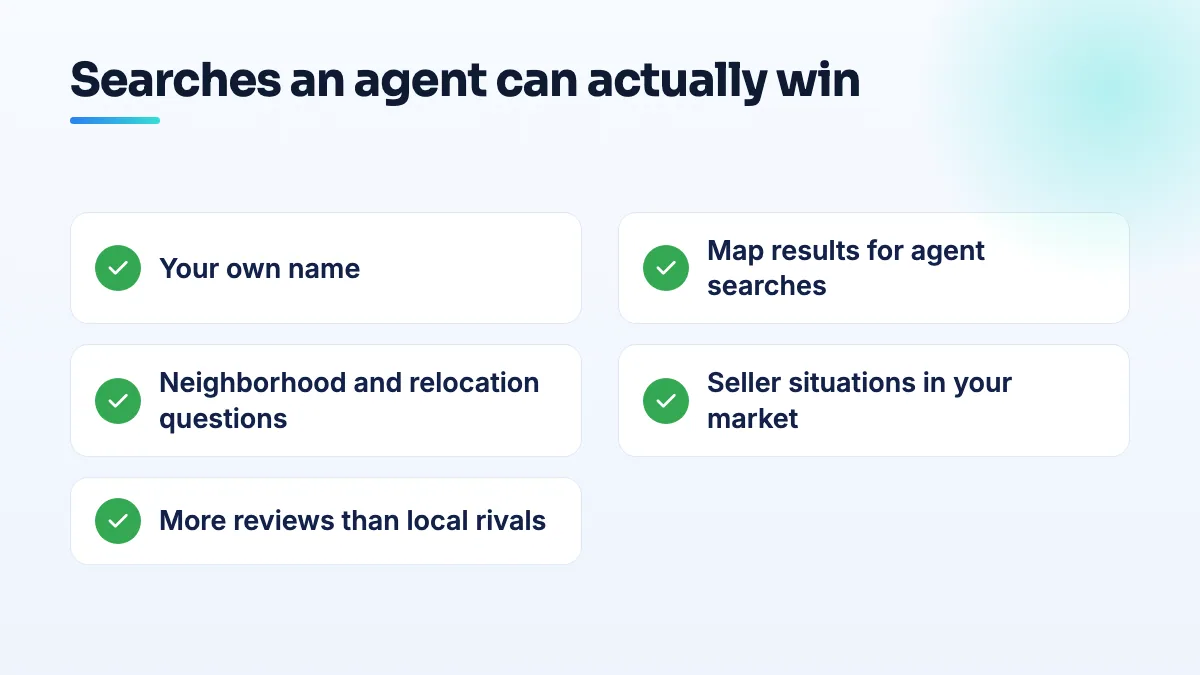
Search "homes for sale" plus your town and you'll see portals and brokerage brands from top to bottom, with no individual agent in sight. A real estate agent who wants to rank beyond Zillow has to stop chasing that search and go after the ones where a person beats a database: your own name, the map results for agent searches, and specific local questions a portal can't answer.
This matters even more when your brokerage owns your website and you can't edit your own page. The good news is that the search asset that matters most for an agent isn't the website at all. It's the Google profile, and that one you can control.
What page one actually looks like for listings searches
When I checked in September 2026, a search for "homes for sale Naperville IL" returned Redfin, Zillow, Coldwell Banker Realty, Trulia, Coldwell Banker again, Homes.com, Sotheby's, Baird Warner, @properties and Berkshire Hathaway HomeServices. Ten results. Not one individual agent.
That isn't a Naperville quirk, and it isn't something better SEO fixes. Portals have every listing in the market on pages Google already trusts, and the big brokerage brands have the same listings plus decades of links. Your IDX feed shows the same homes they do. If your plan is to outrank them for "homes for sale" in your town, I'd drop it.
The second problem is your website. Plenty of agents only have an agent page on the brokerage site, with the corporate address and a template they can't change. In a Local Search Forum thread about agents whose brokerage controls their web pages, the forum's admin gave advice I agree with: skip the expensive separate website for now and put the effort into the Google profile.
Where a real estate agent can rank beyond Zillow
These are the searches I'd go after, and who usually holds them today.
| Search | Who usually holds it | Can an agent win it? |
|---|---|---|
| "Homes for sale" plus a town | Portals and brokerage brands | Rarely. Not worth the budget. |
| "Realtor near me", "real estate agent" plus a town | The map results, fed by Google profiles | Yes. This is the main target. |
| Your own name | Your profile, your agent page, portal profiles | Yes, and you have to own it. |
| Neighborhood and "moving to" questions | Thin portal pages and forums | Yes, with first-hand local detail. |
| Seller questions for a specific situation | National articles with no local detail | Yes, if you write from your own deals. |
The pattern is simple. Portals win when the answer is a list of houses. You win when the answer is a person, or knowledge only someone who works the area has.
Start with the Google profile
The map results for agent searches come from Google Business Profiles, so this is where most of your effort should go. The forum admin's list was short and specific: complete every field, post every week, and "try to get twice as many reviews as anyone else in town." Here's how I'd do it.
- Get the address model right first. Agents at the brokerage office address are often flagged at verification and filtered once live. For most agents a hidden home address with a service area works better. I cover both options in the real estate agent Google Business Profile setup answer.
- Fill in every field. Primary category, service area limited to the towns you really sell in, a services list (buyer representation, listing, relocation, whatever you actually do), hours, and a plain description of who you help and where. No keyword lists.
- Ask every client for a review, both sides of every deal. Ask at closing, while they're happy, and make it easy with a direct link. Reviews that mention the neighborhood or the kind of sale help searchers pick you. Never buy them and never script them.
- Post once a week. New listings, just-sold homes, open houses, a short note on what's happening in a neighborhood. Posts keep the profile active and give searchers a reason to call you instead of the next agent.
- Add real photos. You at listings you sold, local streets, your team. Not stock images and not the brokerage's logo on repeat.
- Link the profile to a page you control. If the brokerage page is all you have, link that. If you have your own site, link it there, so the profile and site survive a brokerage change together.
If the brokerage controls your website
You have three realistic choices, and you can do them in order.
- Make the most of the page you have. Ask the brokerage which fields you can edit: bio, photo, service areas, testimonials. A full bio that names the neighborhoods you work is better than the default template.
- Build a small site on your own domain when you're ready to write for it. Your name, the areas you serve, your reviews, a contact form and a handful of genuinely useful local pages. It doesn't need to be expensive, and it moves with you when you change brokerage. I'd only do this once the profile is in shape, which is also the admin's point.
- Don't build a site that's just an IDX feed. The listings are the same ones every portal shows. What ranks is what they can't publish.
The forum admin also suggested using a separate address so your profile isn't filtered against the brokerage's listing. That's the home-address model again, and it's the reason I start every agent with the address question.
Content a portal can't write
If you do publish, write the pages only you can write. A few that work well for agents:
- Neighborhood comparisons from the ground. Two areas buyers weigh against each other, with what you've seen on commutes, lot sizes, noise, flooding streets and which blocks sell fastest.
- Seller situations. Selling an inherited house, selling while buying, selling a house with tenants, all in your market and from your own process.
- Relocation pages. What someone moving to your area from a specific city usually gets wrong about prices, taxes or neighborhoods.
- A niche you really work. Condos, acreage, first-time buyers, a specific development. Depth in one niche beats thin pages on everything.
This is the same approach I use to compete with directories in search in other industries where aggregators hold the top results.
What not to do
- Don't pay for pages targeting "homes for sale in" every nearby town. You're up against portals with every listing, and copy-paste town pages are a risky tactic in 2026. Contractors on the Local Search Forum reported location pages falling out of the index in a Local Search Forum discussion on service-area pages and the August 2026 spam update.
- Don't create a profile for every town you serve. One agent, one profile, with a service area.
- Don't stuff the profile name. A title like your name plus "Best Realtor" and a town gets reported and suspended. Your name is enough.
- Don't leave your name search to the portals. People who get your card will search your name. Make sure your profile and a page you control show up for it.
Where to start this week
Fix the profile first, then decide about a website. That order gets most agents further than any amount of listings content. If you want help with the searches worth winning in your market, it's the core of our realtor SEO work, and the profile and review pieces are part of our local SEO services.
Written by Saifur Rifat, Founder & SEO Lead at SERP Squad.