

You're licensed, the rooms are ready, and nobody has enrolled, because parents don't want to be the first family at a center with no children and no reviews. Getting your first daycare enrollments comes down to two things: being visible in the three places parents actually check before they tour, and giving the first families a low-risk way to try you.
New owners describe this exact trap. In a Reddit thread from a newly licensed daycare that couldn't get its first family, the owner's problem was that families wanted proof of other families. In a Reddit thread about a new center that opened with no children, what finally worked was a drop-in trial month.
Below is where parents look, the order I'd set things up in, and the mistakes that cost new centers their first year.
Why a new center can't get its first family
Choosing childcare is one of the most anxious decisions a parent makes. They want evidence that other families trust you: children in the photos, reviews from parents, a name they've heard in their local group. A new center has none of that on day one, so it looks riskier than the older center down the road, even if yours is better.
The old playbook doesn't close the gap anymore. Providers in a Reddit thread from providers whose open houses stopped filling rooms describe running open houses and putting a sign out front with empty rooms to show for it. A sign reaches people who drive past. Most parents start looking on their phone long before they drive anywhere.
Where parents find a daycare: three places, not one
In a Reddit thread where working parents describe how they found childcare, parents describe checking Google Maps, their state's licensing directory and local Facebook parent groups before they ever book a tour. A new center needs to show up well in all three, because a parent who finds you in one will check the other two.
- Google Maps. This is where "daycare near me" searches land. Parents see your name, your photos, your hours and your reviews before your website. A profile with no photos and no reviews looks closed.
- The state licensing directory. Parents use it to confirm you're licensed and often to look at inspection reports. If the name, address or phone there doesn't match your Google profile and website, it looks like a different business.
- Local parent groups on Facebook. This is where parents ask "does anyone know the new place on Main Street?" If nobody answers, or the only answer is a guess, you've lost that family.
How to get your first daycare enrollments, step by step
This is the order I'd do it in for a new center. Start the website and licensing checks before you open, and the profile as soon as the center is staffed at its address.
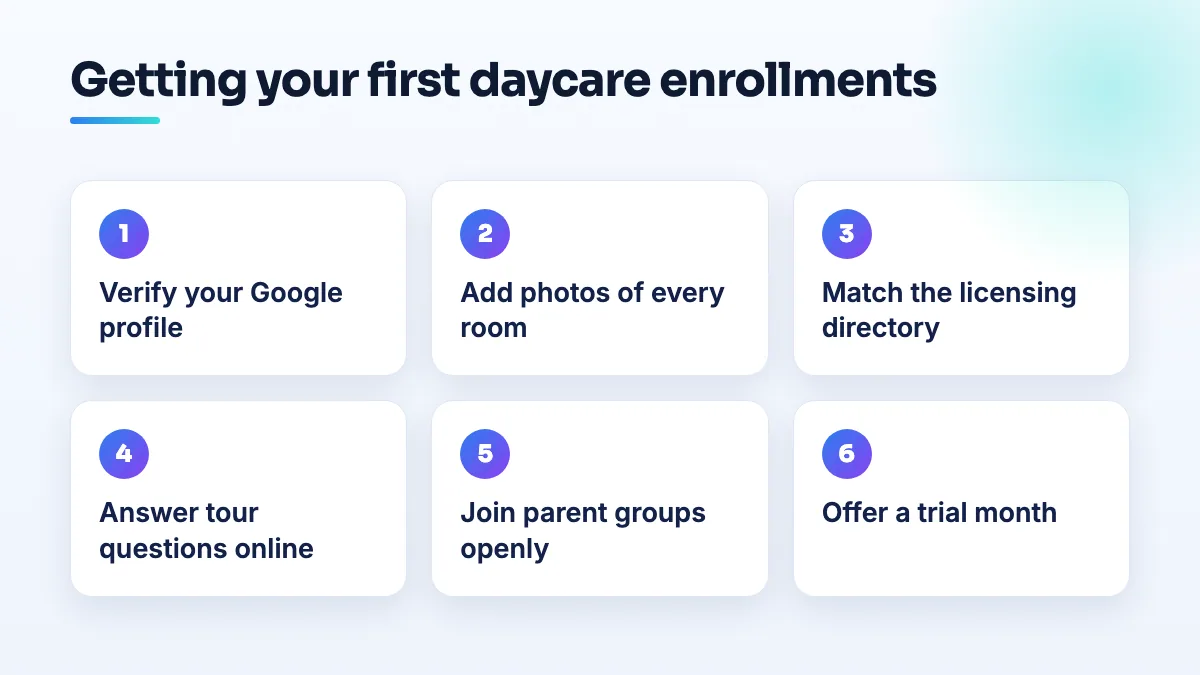
- Set up and verify your Google Business Profile at the center's address. Use the licensed business name, not a name with "best" or your town in it. Pick the category that matches what you are, such as a child care agency or preschool. Add your real hours, the ages you take and a phone that someone answers during the day.
- Fill the profile with photos parents want to see. Every room, the outdoor play area, the entrance, the kitchen and the sleep area, in daylight. Add your staff photos and qualifications if staff agree. Once children attend, only post photos of them with written parent consent.
- Match your licensing directory listing exactly. Check the name, address and phone in the state directory, and make your Google profile and website use exactly the same details. If something in the directory is wrong, ask your licensing office how to correct it.
- Build a website that answers the tour questions. A page for each age group, your daily schedule, tuition and what it includes, your license number, your staff ratios, and a way to book a tour on any weekday, not just on an open house date.
- Join your local parent groups as the owner, openly. Read each group's rules first. Introduce yourself once, say you've opened, where and for which ages, and offer to answer questions. Then answer questions when parents ask about childcare in your area. Don't post the same ad every week.
- Offer a drop-in trial month. That's what filled the empty center in the Reddit thread above. A parent who can try you for a few days a week without signing a long contract has much less to lose, and a child who's happy in week two is the best sales argument you'll ever have.
- Ask the first families for honest reviews. Once a family has been with you a few weeks, ask them to leave a Google review in their own words. The first five or six reviews change how every later parent sees your profile.
How I'd set up a trial month
The thread doesn't give a template, so this is how I'd structure one to be fair to you and to parents.
- Put the terms in writing. How many days, which hours, the price, and what happens at the end of the month. No surprises either way.
- Make the path to a full place clear. Say how a trial family can move to a full-time or part-time place and whether their trial spot is held.
- Tell parents what you'll share with them. A short daily note or photo update (with consent) shows the care that a review can't yet.
- Say it everywhere parents look. Add it to your Google profile as a post, put it on your website's enrollment page, and mention it when you answer questions in parent groups.
Why ads alone won't fill a new center
Paid ads can help, but I wouldn't build a new center's first year around them. In a Reddit thread from a childcare advertiser restricted by Google Ads, the owner describes childcare ads being restricted under Google's health and personalized advertising rules after two years without problems. If your ads can be switched off overnight, they can't be the only way families find you. If you do advertise and get restricted, read the exact policy named in the notice before you change anything.
Your Google profile, your website and your reputation in parent groups keep working whatever happens to an ad account.
What's different for in-home daycares and franchises
- In-home daycares are much harder for parents to find online. Parents in a Reddit thread from parents looking for in-home childcare say centers are findable on Google and home daycares mostly aren't. Setting up an in-home daycare Google listing raises address and privacy questions that a center doesn't have, so read that first.
- Franchise preschools get brand support but still need their own local work. An owner in a Reddit thread from a franchise preschool owner nine months in was still looking for an enrollment model. Make sure your location's Google profile is yours to manage and that your local page on the franchise site has your own photos, staff and tour times.
What not to do
- Don't post fake reviews or ask friends to pose as parents. Parents compare notes in local groups. One exposed fake review costs more trust than having none.
- Don't leave your deposit and hold policy vague. Parents describe spot and deposit disputes that turn into public complaints, as in a Reddit thread about a daycare deposit dispute. Put the rules in writing before anyone pays.
- Don't rely on one open house. Offer tours any weekday. A working parent who can't make Saturday at 10 will tour somewhere else.
- Don't stuff your town into your business name. It doesn't match your license, and Google treats keyword names as a reason to suspend.
- Don't wait until opening day to start. Profile, photos, website and licensing details should be ready before the first family visits.
After your first families
Once rooms start to fill, the problem changes to managing interest you can't take yet. That's where a daycare waitlist page helps, because families on a waitlist are your next enrollments. If you'd like the launch done for you, it's what our daycare SEO work covers, starting with Google Business Profile optimization before the doors open.
Written by Saifur Rifat, Founder & SEO Lead at SERP Squad.