

If most of the calls you get are people asking what you charge to mow or how cheap you can lay a patio, your search presence is attracting the wrong job. Landscaping design build leads come from a different set of searches, a different kind of page and a different enquiry process, and you can steer toward them without giving up the maintenance work that pays the bills in the meantime.
One landscaper on LawnSite put numbers on the problem that most owners only feel. In a LawnSite discussion on selling a design when the client wants a price, he described his calls as half price shoppers, a quarter people collecting quotes from several companies and only a quarter genuinely interested in design and build. And he was still giving every one of them a free on-site estimate.
Below is why that split happens, how I'd change the website and Google profile to shift it, and how to qualify people before you drive out.
Why most landscaping calls are price shoppers
The calls you get are a mirror of the searches you show up for and the pages people land on. If your site's main message is "lawn care, mowing, cleanups, free estimates" and your photos are striped lawns, you'll be found by people comparing weekly mowing prices. That isn't a bad customer. It's just not the customer who wants a whole new backyard built.
Ranking by itself doesn't fix this. Another owner started a LawnSite thread about ranking well but getting little work, and it's a pattern I see often: a site that ranks for its town name and a generic trade phrase, with nothing on it that makes a design client pick up the phone. A different LawnSite owner found he ranked for "lawn care" plus his town when, as he put it, people actually search for lawn mowing. The words you rank for decide who calls.
Shared-lead platforms make the price problem worse. Landscapers on LawnSite describe Angi leads going out to around ten contractors at once. When ten companies get the same enquiry, the homeowner has been set up to compare prices before anyone has seen the yard.
What design-build clients look for before they call
A homeowner planning a patio, retaining wall or full backyard isn't choosing a vendor for a weekly chore. They're choosing someone to trust with a big check and months of disruption. In my experience they want three things before they call anyone:
- Proof you've built this exact thing. Photos of finished patios, walls, steps and planting in yards like theirs, ideally with the neighborhood named.
- A sense of the price range. Not a quote. A range that tells them whether they're in the right conversation at all.
- How the process works. Consultation, design, approval, build, and roughly how long each takes.
A mowing-focused site shows none of that, so the design client scrolls past and calls the company whose site does.
How to shift your site and profile toward landscaping design build leads
This is the order I'd do it in. None of it means dropping maintenance. It means the design and hardscape work gets its own pages, its own photos and its own way in.
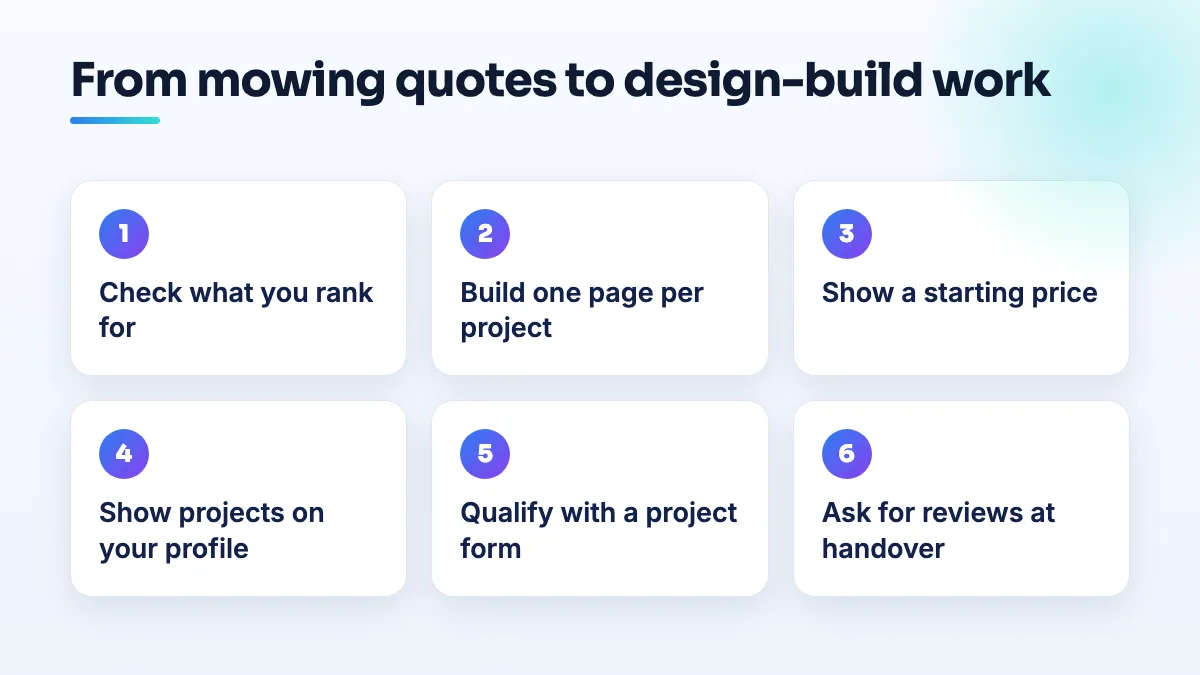
- Find out what you actually rank for. Open Google Search Console, look at the queries report for the last three months and sort every search into two piles: maintenance (mowing, cleanup, fertilizing) and project work (patio, pavers, retaining wall, landscape design, outdoor lighting). If the project pile is nearly empty, that's your answer. I explain how to read this in the guide to customer search terms vs trade terms.
- Build one page per project type you want more of. A paver patio page, a retaining wall page, a landscape design page, and so on. Each one gets photos of your own finished local jobs, what the project involves, how long it usually takes, the materials you work with and the towns you serve. One strong page per service beats a single "hardscaping" page listing everything.
- Put a starting price on each project page. Use your own numbers: "most of our paver patios land between X and Y" or "design-build projects start at Z". That one line does more filtering than anything else on the site, because the people it scares off were never going to hire you. If you're unsure, I've written about whether to put prices on your website.
- Make your Google Business Profile show the projects. Pick the primary category that matches the work you want most and add a design-focused category as a secondary one only if you really do design. Add each project type as a service with a plain description, and post photos of finished hardscape jobs every few weeks, not just mowing.
- Replace "free estimate" with a project enquiry form. Ask for the project type, a rough budget band, when they want it done, the property address and a couple of photos of the yard. Short enough to finish on a phone, specific enough that a price shopper stops halfway.
- Ask design clients for a review at handover. Ask plainly, in person, when the job is finished and they're happy. Reviews that mention "patio" or "retaining wall" in the client's own words help the right people find you. Don't pay for them: one owner on LawnSite handed gift cards to all 21 of his clients, spent $500 and got no reviews at all, while plain asking worked for others in the same discussion.
How to qualify landscaping leads before the free site visit
The LawnSite owner's split only hurts because every call became a drive-out. The fix is to qualify on the phone or the form, and only visit the people who fit.
These are the questions I'd get answered before anyone gets in the truck:
- What's the project? A patio, a wall, a full redesign, or a mowing quote that reached the wrong department.
- Have you set a budget range? Offer bands out loud ("most patios like that run between X and Y, is that about where you are?"). Silence tells you as much as an answer.
- When do you want it done? Someone planning for next season is a design client. Someone who needs it before a party on Saturday usually isn't.
- How many companies are you getting prices from? Asked politely, most people will tell you.
- Can you send photos of the space? People who send photos are serious. People who won't rarely are.
My advice for real design work is to stop giving the design away. Many design-build firms charge a consultation or design fee and credit it against the build if the client goes ahead. Whether that suits your market is your call, but a free visit plus a free drawing is exactly how the price shopper gets a plan to hand to a cheaper crew.
Where price shoppers come from, and what to cut
- Shared lead platforms. A lead sent to ten companies is a price comparison by design. Landscapers in a Facebook group also complain that Thumbtack bills for leads they were merely matched with. I break down the per-job math in the post on Angi and Thumbtack shared lead cost.
- A homepage that leads with mowing. Keep maintenance on the site, but put your best finished project at the top and make it clear what kind of company you are.
- "Free estimates" as the main call to action. It invites anyone who wants a number. "Book a design consultation" invites the people you want.
- Photos that don't show projects. A gallery of cut lawns tells a design client you cut lawns.
What not to do
- Don't drop maintenance before project work replaces it. Mowing accounts are steady income and often turn into design work later. Separate them, don't abandon them.
- Don't copy the same project page for every town. Twenty pages with the town name swapped look like a doorway scheme and read like one. One strong page per service with real local jobs does more.
- Don't use stock photos of projects you didn't build. Design clients look closely, and the first site visit will give it away.
- Don't stuff "design build" into your Google business name. Keyword-stuffed names are a known suspension trigger. Your registered name is the one to use.
Questions people ask
Should I stop offering free estimates altogether?
For small maintenance jobs, a quick free quote is normal and fine. For design work, I'd qualify first and consider a consultation fee credited to the project. The owner in the LawnSite thread was spending half his estimate time on people who only wanted a price.
When should I start pushing project work?
Homeowners plan backyards over the winter, which is exactly when many landscapers go quiet. I cover the timing in the post on landscaping winter marketing.
How long before the calls change?
New pages and profile changes take weeks to months to show in search, and it depends on your market. Track the split yourself: note on every call whether it's maintenance, a comparison quote or a real project, and watch how the mix moves over a season.
Where to start
Pull your Search Console queries this week and count how many are project searches. That tells you how far you have to go. If you'd rather have it done for you, project pages and profile setup are the core of our landscaping SEO work, and the pages themselves come from our service page writing team.
Written by Saifur Rifat, Founder & SEO Lead at SERP Squad.