

A buyer lands on your wrap page, sees "Contact us for a quote" and nothing else, and leaves for the shop down the road that at least gave a starting number. That is the real cost of opaque vehicle wrap pricing: the good buyers leave before a price exists, and the ones who stay are often the ones shopping on price alone.
My answer for most sign and wrap shops is a mix. Publish flat "from" prices for the jobs you do every week (a standard van, a pickup, a partial with cut graphics), keep custom quotes for fleets and specialty work, and put a quote form in front of both that asks the questions that actually change the price. Below is how I'd set each part up, and how to stop price shoppers eating your afternoons.
Why wrap buyers leave before you've quoted
Sign people talk about this openly. In a Signs101 discussion on flat pricing for vehicle wraps, the worry is that wrap quoting is so opaque that buyers give up before they ever get a number. From the other side of the counter, small business owners in a Reddit thread from buyers comparing sign quotes describe sending what they thought was the same brief to several shops and getting prices that were wildly different. Neither side trusts the number, so both sides waste time.
Then there's the undercutting. In a Signs101 thread on what it costs to hire a vehicle wrapper, and again in a thread on installer labor costs, installed prices around $8 to $10 per square foot come up as the kind of number shops are competing against. If your price lives only in your head, the first number a buyer sees is someone else's, and that becomes the anchor you're judged against.
So the problem isn't that you charge too much. It's that you give the buyer nothing to compare you with except the cheapest shop that bothered to answer.
Flat rate vehicle wraps or custom quotes: which jobs get which
Not every job can carry a published price, and I wouldn't try. This is how I split them for sign shop clients.
| Job | Pricing approach | Why |
|---|---|---|
| Standard vans, pickups and cars in common sizes | Flat "from" price by vehicle class and coverage | You do them often enough to know your material and hours |
| Partial wraps and cut vinyl lettering packages | Flat package price with a size limit | Buyers compare these most, so a visible number wins the click |
| Box trucks, trailers and step vans | Price range per foot of body, final after measuring | Body sizes vary too much for one number |
| Fleets of five or more vehicles | Custom quote after a consult | Design, scheduling and rollout matter more than per-vehicle price |
| Color change, specialty films, paint prep issues | Custom quote after inspection | The vehicle's condition changes the job |
The flat rows do the selling. The custom rows do the qualifying. A buyer who sees "Full wrap, cargo van, from $X" and still fills in your form has already accepted a price range, which is exactly the conversation you want to be having.
If you're still deciding whether to show numbers at all, I cover the wider question of whether should you put prices on your website for local businesses in a separate answer. For wraps, my view is simple: a "from" price beats silence.
How to set vehicle wrap pricing you can publish
A published price only works if you can live with it on a bad day. Build it from your own numbers, not from what the shop across town seems to charge.
- Pull your last 20 wraps and group them by vehicle class. Write down film used, print and laminate time, design hours, install hours and any rework for each. The groups that look alike are your flat-rate candidates. The ones all over the place stay custom.
- Price each class from its worst normal job, not its best. Use the job in that group that took the longest without anything going wrong. That becomes your "from" price. It protects you from quoting the easy van and then wrapping the one with the rusty sills.
- Write down what the price includes. Coverage (full, three quarter, partial), whether design is included and how many proofs, film type, and whether removal of old graphics is extra. Buyers compare wrap quotes badly because nobody lists these. Listing them turns a cheaper competitor's number into a question the buyer asks them.
- Publish ranges, not exact figures, for anything with variables. "Box truck sides and rear: from $X to $Y depending on body length" is honest and still useful. A buyer can tell in five seconds whether they're in your world.
- Put the prices on a page built for the search, not buried in a PDF. One page for vehicle wraps with the flat packages, the ranges and photos of real installs for each class. That page is what ranks for "vehicle wrap cost" in your city, so it needs the words buyers use and your location, not just a gallery.
- Review the numbers every quarter. Film prices and your hours change. If you're winning every flat-rate job, you're probably too cheap. If nobody fills in the form after reading the page, check whether a competitor has published a lower starting point.
The wrap quote form that gets a real brief first time
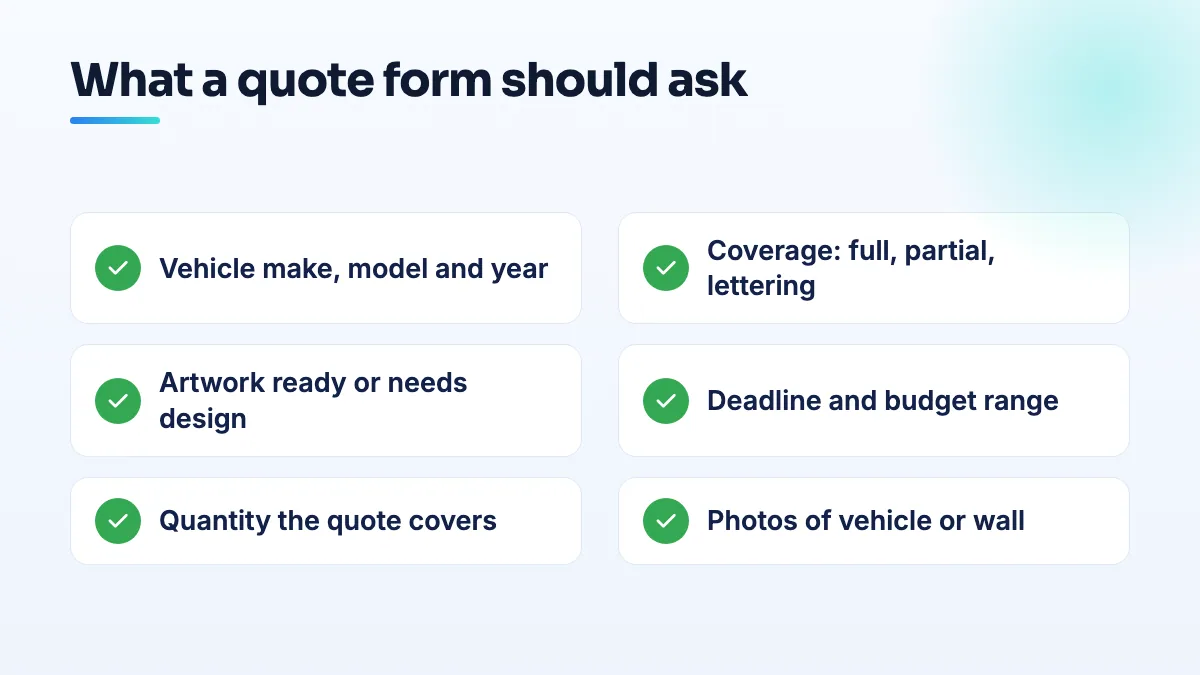
"How much for a sign?" is the enquiry every sign shop gets and nobody can answer. The fix is to ask the questions in the form instead of in a week of emails. These are the fields I'd put on a wrap and sign quote form, in this order:
- What is it? Vehicle wrap, window graphics, building sign, banner, fleet. One choice, so the rest of the form can change to match.
- For vehicles: make, model, year and coverage. A dropdown for full, partial or lettering only. Ask for two photos of the vehicle, side and rear.
- For signs: size, where it goes and whether it's lit. A photo of the wall or window with rough measurements. Add "Do you know if you need a permit?" as a yes, no or not sure question.
- Artwork status. "Print-ready files", "Logo only" or "Need design". This single question explains most of the difference between two shops' quotes.
- Deadline. A date, not "ASAP".
- Budget range. Offer bands that start at your lowest realistic job. People who pick the lowest band on a full wrap are telling you something useful.
- Quantity. One vehicle or a fleet, one sign or a rollout. Say in plain words that the quote is for the quantity entered.
That last field matters. Shop owners on Signs101 share stories of customers who get a price for 600 signs and then order 50 at the same unit price. Tying the quote to a stated quantity, and saying so on the form and the quote, ends that argument before it starts.
The form sits on your site, so it's a website job as much as a pricing one. If yours is a single contact box, that's the first thing I'd change in any website design brief for a sign shop.
How to handle wrap price shoppers and undercutters
You can't stop another shop charging $8 a foot. You can stop letting it set your terms.
- Answer price-only enquiries with your published page. A short reply with the link and "Our cargo van packages start here; send two photos and I'll confirm" filters out anyone who only wanted the lowest number, without you writing a custom quote.
- Show what cheap installs miss. Photos of lifting edges, bad seams around handles and film that failed after a summer are more persuasive than any sentence about quality. Pair each with how you handle that area.
- Put your warranty and film brand next to the price. A buyer comparing your "from" number with a lower one should see straight away what they get for the difference.
- Don't match, re-scope. If a buyer has a lower quote, offer a partial or a lettering package that fits their budget. You keep your rate and they get a real option.
Cheap work crowds out profitable work, and sign shop owners on the forums say as much: one thread describes regulars calling $6 per square foot for cut vinyl and install too expensive. My advice is to let your published prices and your form do the saying no for you. The time you get back is better spent chasing sign shop commercial clients who buy fleets and rollouts.
What not to do
- Don't publish a price you'd refuse to honor. A "from" price that no real job ever hits will cost you more in trust than silence did.
- Don't hide everything behind "request a quote". It's the exact pattern buyers say pushes them to the next shop.
- Don't quote a full wrap from a make and model alone. Ask for the photos. Paint condition and body shape are where jobs go wrong.
- Don't build an online design tool to win quick orders. Shop owners who tried one report it mostly brought in tiny jobs from people with no budget, not the local buyers they wanted.
- Don't send a quote without the quantity and inclusions written on it. It's the easiest dispute to prevent.
Questions sign shop owners ask
Won't competitors just undercut my published price?
Some will. They could already, since any buyer can ask you for a number and forward it. What a published price changes is who calls you: people who've seen the number and still want to talk.
Should I show prices for building signs too?
For standard items like window lettering, A-frames and banners, yes. For building signs, show a range and explain what moves it: size, illumination, installation height and permits. I explain the permit side in the post on who pulls the sign permit, because it's one of the biggest swings in a sign quote.
How many form fields is too many?
If a field changes your price, keep it. If it doesn't, remove it. A buyer who wants a wrap will answer six questions; one who won't answer six was never going to pay your rate.
Where to start
Pick the three vehicle classes you wrap most, price them from your own job history this week, and replace your contact box with the form above. Getting that page to rank in your area is the other half, and it's the core of the sign shop SEO work I do.
Written by Saifur Rifat, Founder & SEO Lead at SERP Squad.