

The 25D homeowner tax credit was the backbone of most residential solar sales pitches, and with it gone, the "own your panels and get 30% back" message that regional installers built their websites around no longer holds up. Solar marketing after the 25D repeal has to answer different questions: is solar still worth it here, should I lease or buy, and why should I trust a local installer over the company knocking on my door.
This hits the regional installers hardest, the ones without the volume of the national companies. The answer isn't a cheaper headline price. It's being the installer whose website answers those questions honestly, with local numbers, before the homeowner talks to anyone else.
What changed for regional installers after 25D
pv magazine's reporting on a new coalition formed to lower costs for regional solar installers quotes an installer who put the problem in one line: "I really want to sell ownership… but I can't compete right now." The competition he means is third-party ownership, mainly prepaid leases, which can currently be offered at prices a regional installer selling cash or loan purchases can't match.
The same piece describes the Strong Tail Solar Alliance, set up for mid- to long-tail installers that lack the volume to match national competitors on equipment and service costs. Its webinars cover sales funnel management, pricing strategy, tariffs and working capital. In other words, the survival skills now are business skills, not install skills.
Solar Power World's residential solar news coverage shows the rest of the picture: acquisitions and consolidation among installers, and more attention on batteries, virtual power plants, repair and remote inspection. The market is still there. The pitch that sold it has changed.
The questions homeowners are searching now
When the easy answer disappears, buyers start researching. These are the questions I'd build a solar installer's content around now, because each one is a moment where the homeowner is deciding who to trust:
- Is solar still worth it where I live? Asked with the town or state, and asked by people who heard the credit ended.
- Should I lease or buy? The lease salesperson has a monthly number. They want to know what they're giving up.
- What happens to my system if the installer goes out of business? After a wave of closures and acquisitions, this is a fair question.
- Do I need a battery? Especially where utility rules or outages make storage part of the conversation.
- Is the person at my door legitimate? Door-to-door canvassing is still a main sales channel in solar, and homeowners check.
Most installer websites I look at answer none of these. They have a homepage, a financing page that still mentions the credit, a gallery and a quote form. That's a site built for a buyer who had already decided.
How to rebuild your solar marketing after the 25D repeal
- Remove every mention of the credit first. Search your website, your Google Business Profile description and posts, your ads and your printed leave-behinds for "25D", "30%", "tax credit" and "federal incentive". A stale incentive claim is misleading to a buyer and gives a competitor or a regulator something to point at. Replace it with what's true today for your state and utility.
- Publish an honest "is solar still worth it" page for your area. Use your own numbers: your local utility's rates, the system size you typically install, your cash price range, and how you calculate payback with and without a battery. Say plainly who it doesn't make sense for, such as heavily shaded roofs or a roof due for replacement. That page earns trust the sales call can't.
- Write a fair lease versus purchase comparison. You can't win the monthly number, so don't pretend. Compare the things a homeowner should ask about either way: who owns the equipment, what happens when they sell the house, who pays for repairs, whether payments rise each year, and what happens at the end of the term. If a lease genuinely suits some buyers better, say so. Being the installer who says that is how you get believed on everything else.
- Build pages for the work you can still sell well. Batteries added to existing systems, system expansions, repair and service. Owners of systems whose installer closed need someone, and I cover that side in the post on becoming a solar panel repair company for orphaned systems.
- Answer the door-knocker on your own site. Write a page listing the questions to ask any door-to-door solar salesperson: who installs the system, who services it, whether the company is licensed in your state, where their office is and who to call in ten years. Then answer every one of them for your own company on the same page.
- Tighten the Google Business Profile. Use your real registered name, keep the service area to where your crews actually drive, and post photos of local installs with the town named. Ask every recent customer for a review. A homeowner comparing a local installer with a national lease provider checks the reviews first.
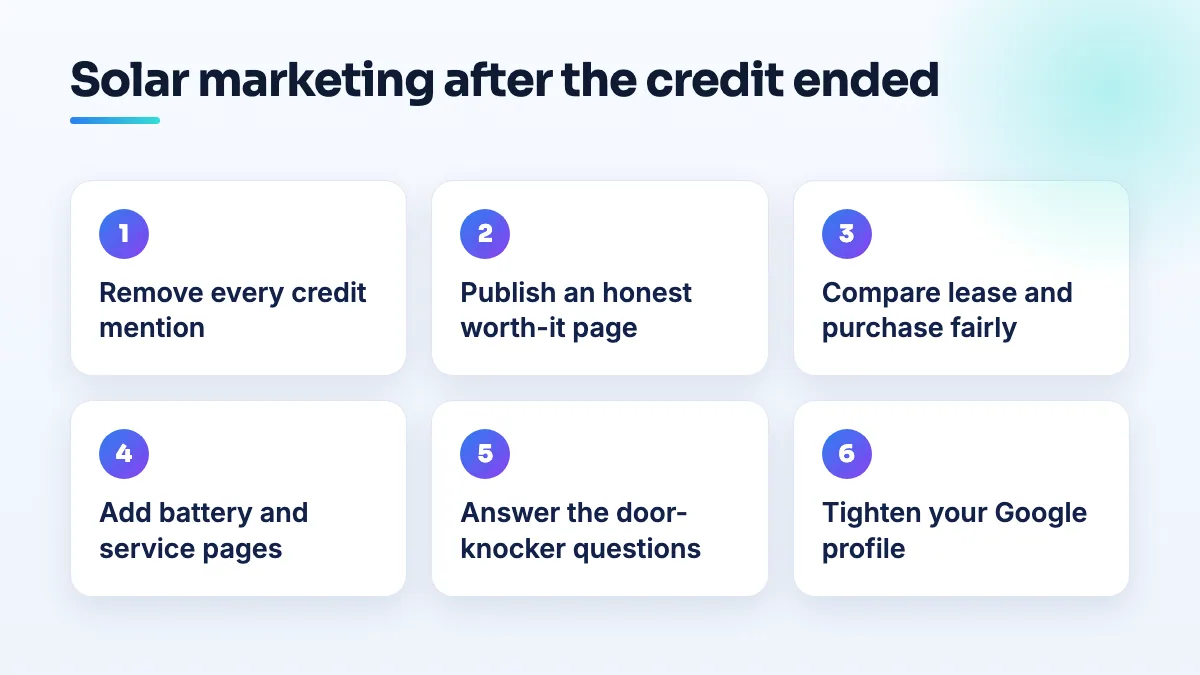
How to compete with solar leases without lying about price
The installer in the pv magazine piece is right that you can't match a prepaid lease on price right now. So stop leading with price. What a regional installer can offer that a lease often can't is clarity and continuity.
| What the homeowner worries about | What your site should show |
|---|---|
| Who fixes it in year eight | Your service team, your address, your warranty terms in plain words |
| Selling the house later | How an owned system transfers, and what to ask about lease transfers |
| Rising payments | Your cash and loan options side by side, with no escalator |
| Being sold to by a stranger | Named people, your license number, local jobs with the town named |
| Whether the numbers are real | Your payback method, shown step by step, using local rates |
If you offer a lease or power purchase agreement through a financing partner yourself, put it on the same comparison page. Buyers respect an installer who shows every option and tells them which one fits.
Door to door solar competition: what I'd publish
Canvassers reach the homeowner first. Your content has to be what they find when they search your company, or the canvasser's company, afterward. Three pages do most of that work:
- A "questions to ask a solar salesperson" page with honest answers for your own business.
- A "what we install and service" page naming the panel, inverter and battery brands you work with.
- A local projects page with real installs, the town, the system size and a short note from the owner where they agreed to it.
None of this needs a big budget. It needs someone to write it clearly, from what your sales team already hears every week.
What not to do
- Don't keep the credit on your site "until you get round to it". Every week it stays up, you're quoting a buyer a benefit they won't get.
- Don't rename your Google profile in a hurry. A licensed solar contractor in a Help Community thread about a solar company renamed to match its LLC was suspended for deceptive content right after the change and was invisible for two weeks. If you're rebranding or merging, read what triggers deceptive content on a Google Business Profile before you touch the name.
- Don't make fifty city pages. One honest page per real question does more than the same page copied for every town.
- Don't attack lease companies by name. Explain the trade-offs and let the buyer decide.
Where to start
This week, search your own site for "30%" and "tax credit" and fix every page that comes up. Then write the "is solar still worth it" page with your real local numbers. If you want help with the content and the local rankings behind it, that's what our solar installer SEO work covers, and the pages are written by our SEO content writing team.
Written by Saifur Rifat, Founder & SEO Lead at SERP Squad.