

Your tow company has been suspended again, or it's verified and nowhere to be found, and it feels like Google has it in for you. In a sense it does. When a Google Business Profile for towing gets suspended, it's usually because towing is a category Google watches more closely than most, so settings and reviews that another trade might get away with will sink a tow company.
The answer isn't to fight the scrutiny. It's to run the profile so there's nothing to find: correct settings made once, edits planned instead of made on a whim, and reviews only from real customers. Here's why towing gets this treatment and exactly how I'd set a tow profile up to survive it.
Why a towing Google Business Profile gets suspended more than most
This isn't a theory. A verified tow company in Tampa couldn't show up even when people searched its own name. Gold Product Expert Tony Gricar replied in Tony Gricar's reply to a tow company invisible for its own name that it was an SEO issue, that there's no support for ranking problems, and that "Google does put greater scrutiny on towing companies."
The reason is spam. Towing is an emergency search: someone stranded calls the first number they see. That makes it valuable to lead sellers and fake listings. Local news in Denver reported residential homes listed as towing companies on Google Maps, a dozen of them. In Tulsa, a fake tow listing sat on a neighboring body shop's address for two years. When a category is full of that, Google's checks tighten, and legitimate operators get caught in them.
The result shows up again and again in the Help Community. Tow companies suspended and reinstated on a loop. One passed video verification three times and was suspended again each time. Another was told it wasn't eligible to be on Maps at all; in a Help Community thread from a tow company told it wasn't eligible for Maps, the owner lost the reviews and said they were "all gone, because the representative does not understand how Towing and Recovery business operates."
The three settings that get tow companies suspended
One suspended operator in New Zealand diagnosed his own case in a Help Community thread from a suspended tow operator, and it's the clearest list I've seen: "I had set my Service Area to the entire country, my physical address wasn't hidden (as a Service-Area Business), and my category was missing."
Those three show up across towing suspensions. A service area bigger than your trucks could possibly cover. A home or yard address shown when customers don't come there. A primary category that doesn't say towing. Each one looks like a lead-generation listing, and in towing, looking like one is enough.
How to run a towing profile under extra scrutiny
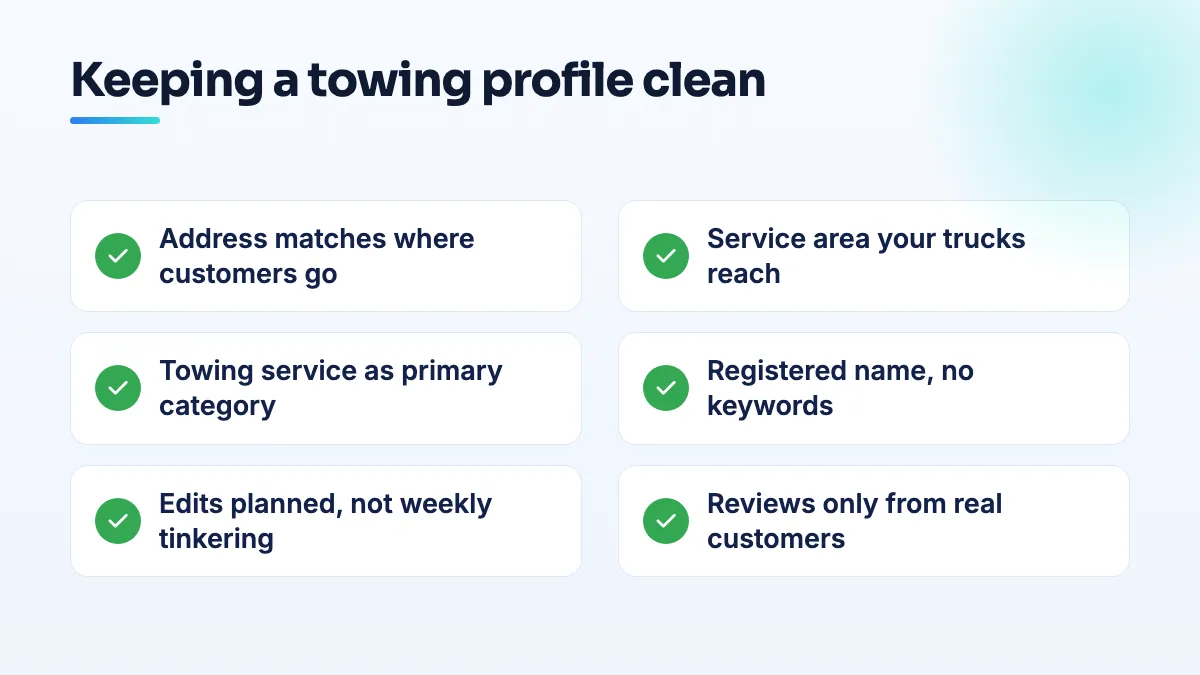
- Set the address to match where customers actually go. If nobody comes to your base, hide the address and run as a service-area business. If you run an impound or storage yard where owners collect their vehicles during set hours, that's a location customers visit: show it, with signage and the hours someone is there.
- Draw the service area where your trucks really respond. The towns and highways you can reach in a reasonable time, not the state or the country.
- Make towing your primary category. Add secondary categories only for services you really provide, such as roadside assistance if you do it.
- Use your registered name and nothing else. No "24/7", no city name, no "cheap". A keyword-stuffed name is exactly what a spam listing looks like.
- Plan your edits instead of tinkering. Practitioners on the Local Search Forum describe tow and locksmith profiles where every edit triggers an audit. Keep a list of routine changes (hours, description, services) and make them in one planned session a few times a year. Make identity changes, meaning name, address, primary category and phone, only when you must, one at a time, weeks apart.
- Keep a verification kit ready. Your trucks with your name on them, equipment, the key to your yard or office, and your towing license or permits, insurance certificates and any rotation or contract paperwork. If Google asks for a video, you film that day, not next month.
- Take reviews only from real customers, asked by you. After a tow, ask the customer directly. No review services, no contractors, no bulk requests.
How cheap review help taints a tow profile
The last step matters more in towing than anywhere else. In a Local Search Forum thread on towing and locksmith verification audits, an owner kept getting audited and suspended every time he edited his profile. Joy Hawkins looked at it and found his reviews were associated with a known spam network, most likely through an SEO contractor he'd hired on Upwork to do reputation "damage control".
That's the trap. My reading is that the contractor's accounts or methods had been used on spam listings before, so the reviews tied his real business to a network Google already distrusted. Every edit after that invited a closer look.
If you've used a service like that, stop now and don't buy more. You can't delete reviews from your own profile, so the practical route is to let genuine customer reviews build up over time and to keep every other part of the profile spotless. If someone offers to "clean up" your reviews for a fee, that's the same trap again.
The same goes for extortion. Owners report one-star reviews followed by messages demanding money to remove them. Don't pay. Report the review, keep the messages as evidence, and post in the Help Community if the report stalls.
If the profile is suspended anyway
Don't start editing to fix it. Every change is another reason for review. Work out which of the settings above was off, correct it once, and appeal with your license, insurance, truck photos and business registration. My guide to deceptive content on a Google Business Profile covers the appeal itself.
If you've already been reinstated and suspended again, like the operator who passed verification three times, the cause is usually still on the profile or in the reviews. The answer on why you can get suspended after passing video verification goes through what to look for.
If you're verified but can't be found
The Tampa company's problem wasn't a suspension. It was live and invisible, even for its own name, and Google's support won't help with ranking. That's an SEO problem: the website, the name consistency across directories, the reviews. If your business is not showing up when searching its name, start there before you touch the profile.
What not to do
- Don't pay anyone for reviews or "reputation management". In towing, it can tie you to a network Google already watches.
- Don't set your service area to the whole state. It's one of the three settings behind the New Zealand suspension.
- Don't edit the profile every week. Plan changes and make them together.
- Don't open a second profile at another yard unless it's staffed and signed, with its own customers.
- Don't report every competitor you dislike. Save your reports for listings that are clearly fake, and document them properly.
Why it's worth protecting
A tow company that's findable on Google gets calls from the people it would otherwise only reach through motor clubs, and the difference in pay is large. Industry figures put a motor club's payment for a tow at about $35 to $55, for the same job a dealership would charge $125 for, according to a towing software company's breakdown of motor club pay. A clean, visible profile is how you win the direct calls. It's the core of our towing SEO work and part of our Google Business Profile management.
Written by Saifur Rifat, Founder & SEO Lead at SERP Squad.