

Hail hits your town and the map pack you've ranked in for years fills with roofers you've never heard of, some of them real crews from out of state and some of them listings that aren't roofers at all. The way to handle storm chasers roofing competition is not to copy them: get your own profile solid before hail season, report the fake listings as one network instead of one at a time, and win the homeowner on proof that a traveling crew can't show.
Roofers on Reddit describe crews that follow hail on doppler radar apps and flood a market after every storm, and a Reddit thread on post-storm roofing competition has local owners talking through how they compete once the chasers arrive. Meanwhile the Google Business Profile Help Community has threads documenting organized fake roofing networks, one of them run from 17 virtual offices.
Those are two different problems with two different answers. Mixing them up is where most local roofers waste the weeks that matter.
Two kinds of storm chasers roofing companies face
Real contractors from out of town. They have trucks, crews and insurance, they follow the weather, and in most places they're allowed to take work in your market. What they can't legitimately do is show up on Google as a local business at an address they don't staff. Google's guidelines for business listings say a business can't list an office at a co-working space unless that office has clear signage, receives customers during business hours and is staffed by the business's own people. A crew that rented a desk in your town for the season fails that test.
Listings that aren't roofers. These are lead-generation profiles on virtual offices, mailbox suites and sometimes empty lots, with names built from search phrases and phones that forward to whoever buys the lead. The fake roofing network thread laid out 17 virtual offices behind one operation. Owners in plumbing, moving and appliance repair describe the same setup in their own markets.
You compete with the first group. You report the second. The difference matters because reporting a real out-of-town contractor who follows the rules goes nowhere, and trying to match a lead-gen network on price, when it has no crew and no overhead, is a race you can't win.
How to spot a storm chaser listing that breaks Google's rules
Before you report anything, check it. These are the signs I look for when a client sends me a list of new names in their map pack:
- The address is a UPS Store, a coworking building or an empty lot. Drop the address into Street View. A "Suite 214" that turns out to be a mailbox number is a classic.
- The business name is a search phrase. "Hail Damage Roof Repair" plus your city name is not a company. Check the state's business register; spam names usually aren't in it.
- Several listings share a phone range, a website template or opening hours. Networks reuse their setup. Two listings with identical hours and near-identical sites are rarely two companies.
- The reviews arrived all at once. A contractor on the Local Search Forum documented a virtual-office competitor that had collected 114 of its 116 five-star reviews in eight months. Look at when the reviews were posted and whether the reviewers have any history.
- Nobody on the website names a person or a license. Real roofing companies, even traveling ones, usually show an owner, a license number and past jobs.
If a new listing passes all of that, it's a real competitor. Treat it like one.
Before hail season: get your own profile ready
The work that decides who gets the calls after a storm happens months before it. This is the order I do it in for roofing clients.
- Finish your profile edits now, not in storm week. Set the primary category to the one that matches most of your work, use your real registered name, hide your address if customers don't come to it, and keep the service area to towns you actually drive to. Owners in several Help Community threads report suspensions that landed right after an address or service-area edit, and licensed roofing companies get suspended for "deceptive content" regularly. You don't want that review happening the week the phones should be ringing.
- Check who owns the profile. The primary owner should be your own Google account, not an agency, a former office manager or a website vendor. If you can't answer the question in one minute, sort it out before hail season.
- Publish storm pages on your website before you need them. One page for hail damage inspection, one for the insurance claim process from the homeowner's side, each with your license number, where you're based and photos of real local jobs. I'd rather see two strong pages than thirty copies with the town name swapped. Some contractors have reported city pages like that falling out of Google's index this year.
- Ask for reviews after every job, all year. A steady run of reviews from homeowners across your area, spread over years, is the one thing a storm chaser can't manufacture in a week. Ask the week the job finishes. Don't script what customers say.
- Set your maximum cost per lead before the storm. Work out your break even cost per lead for Google Ads and Local Services Ads while you're calm. If clicks get expensive after a storm, you'll know the number where you stop bidding instead of guessing.
- Take a dated snapshot of your map pack. Search "roofer near me", "roof repair" and "hail damage roof repair" from a few neighborhoods you serve and save screenshots with the date. After a storm, that baseline tells you exactly which listings are new.
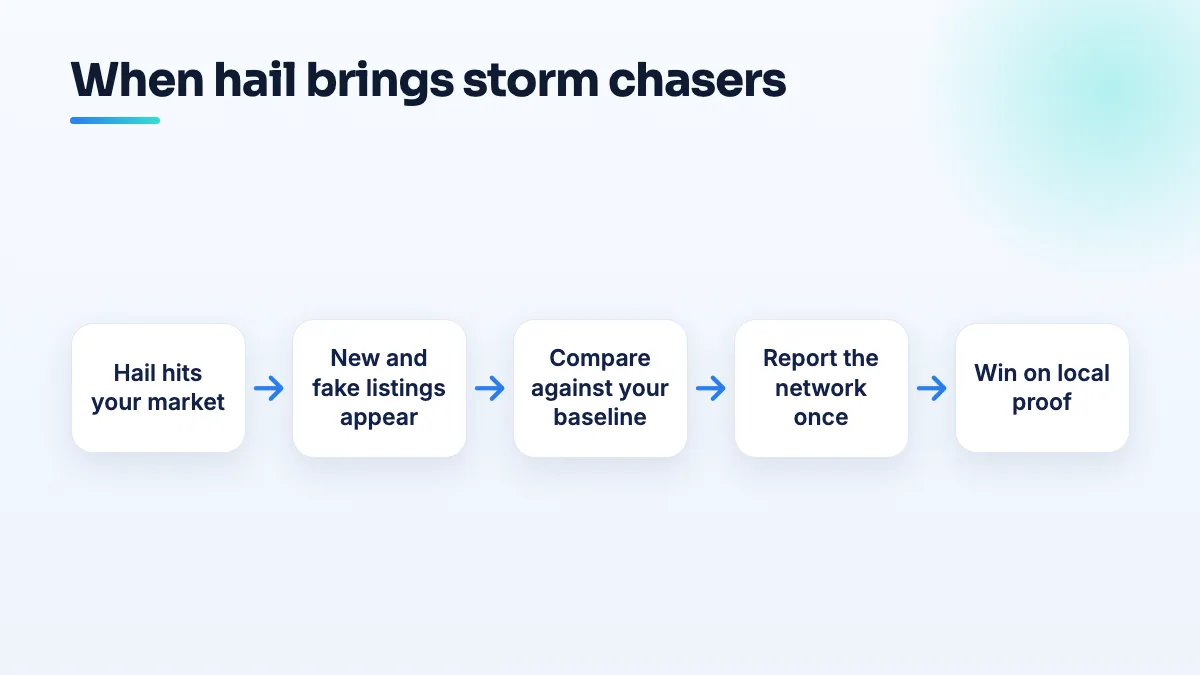
The week hail hits: what to do
- Search from the damaged neighborhoods and compare with your baseline. Make a spreadsheet of every listing that wasn't there before: name, address, phone, website, review count and the date you first saw it.
- Sort each new listing into "real competitor" or "breaks the rules". Use the checklist above. Leave the real ones alone.
- Report the rule-breakers as one network. Put every suspicious listing in the same spreadsheet, show what links them (shared phone ranges, the same website template, addresses that are mailboxes), and submit it through Google's Business Redressal Complaint form. Then post the same evidence in the Help Community. The advice that works, from a thread about fake mover listings, is to report the whole network in one documented submission. In one moving market, 50 fake listings came down about five weeks after a Product Expert escalated them. I walk through the full process for how to report fake Google Maps listings in a separate guide.
- Don't wait on the result. Gold Product Expert Tony Gricar told one owner that "81 days means Google has declined to take action on the profile" after a redressal complaint sat unanswered (Tony Gricar's reply in the redressal complaint thread). Reports take weeks at best. Keep working on the steps below while you wait.
- Answer every call and book inspections fast. After a storm, homeowners rarely call just one roofer. Picking up on the first ring and giving a firm inspection time is the cheapest edge you have, and it doesn't depend on where you rank.
- Keep your ad spend inside the limit you set. If costs pass your break-even number, stop and let your profile and reviews carry the demand.
How local roofers win the job on trust
After a hail storm, homeowners get knocks on the door, flyers on the windshield and calls from companies they've never heard of. Plenty of them are already wondering which of those companies will still exist next year. Your advantage is everything that proves you will be. Put it where they'll see it:
- On your Google profile: photos of roofs you've done in named local neighborhoods, a post about free hail inspections, and replies to your reviews that mention the job.
- On your website: your license number, how long you've been in the area, a physical base customers can find, and a workmanship warranty with your phone number on it.
- On the call and at the door: say plainly that you're local, that you'll handle warranty calls after the storm crews have left, and that you'll walk them through the insurance side.
I'd never tell a local roofer to out-shout storm chasers. Out-last them. The chasers leave when the claims dry up; your reviews and your warranty calls stay.
What not to do
- Don't open a virtual office in the next hail town over. It's the exact tactic you're reporting, and it puts your real listing at risk.
- Don't add "hail damage" or a city name to your business name. It might rank for a week. Keyword-stuffed names are also a known suspension trigger, and competitors report them.
- Don't buy reviews or say yes to "paid review services". One roofer in the Help Community described a fake one-star attack that started after turning such a service down. Buying in is worse.
- Don't report every out-of-town truck you see. Real contractors are allowed to work in your market. Reports on legitimate businesses waste the credibility you need for the fake ones.
- Don't slash your price to match. A lead-gen network has no crew to pay. Compete on the proof you're local, not on the number.
Where to start before the next storm
Hail seasons come back, and the roofers who hold their rankings through them are the ones who did the setup in the quiet months. If you want that done properly, it's the core of our roofing SEO work, and the profile, review and website pieces are all part of our local SEO services.
Written by Saifur Rifat, Founder & SEO Lead at SERP Squad.