

In the world of SEO, NLP has become essential as search engines, especially Google, have evolved to understand not just what users type, but what they mean. This transformation, powered by models like BERT and MUM, has shifted SEO strategies from simple keyword targeting to a focus on delivering comprehensive, contextually relevant content.
Understanding and optimizing your website for NLP isn’t just a competitive edge—it’s becoming a necessity to ensure your content meets both user needs and search engine expectations.
In this guide, we’ll explore what NLP is, why it’s critical for modern SEO, and how you can optimize your website to rank better.
Here is the first half of the blog post on Natural Language Processing (NLP) and SEO:
What is Natural Language Processing (NLP)?
Natural Language Processing (NLP) is a field within artificial intelligence (AI) that focuses on the interaction between computers and humans through natural language. Essentially, NLP enables machines to read, understand, and generate human language in a valuable way. Search engines like Google use NLP to interpret queries more accurately by analyzing the context and meaning behind words rather than just relying on traditional keyword matching.
At its core, NLP relies on several key components:
- Syntax: This refers to the rules governing sentence structure. NLP algorithms analyze how words are arranged in a sentence to extract meaning.
- Semantics: This component deals with the meaning of words and how they combine to create meaning within sentences.
- Pragmatics: Pragmatics is essential for understanding the intended meaning behind words based on context and speaker intent. For example, “Can you pass the salt?” is a request, not just a question.
- Discourse: This is the study of how sentences are connected to each other to form coherent and meaningful conversations or texts.
The Importance of NLP in Modern SEO
NLP has redefined how search engines process and rank websites. Traditionally, SEO focused heavily on keyword matching; ensuring that the keywords typed into search engines were present in your content. However, with the advent of Google’s BERT algorithm and other advancements, search engines are now far better at understanding the intent behind queries.
For instance, Google uses BERT (Bidirectional Encoder Representations from Transformers), an NLP model, to improve its understanding of natural language. BERT allows Google to process words in relation to all other words in a sentence, enabling it to understand context and nuance much better than earlier models. This advancement has particularly impacted long-tail queries and voice searches, both of which are more conversational.
NLP helps search engines achieve the following:
- Better User Intent Recognition: By focusing on what the user truly wants, rather than just the keywords they type, search engines can provide more relevant results.
- Contextual Understanding: NLP enables search engines to look beyond keywords and analyze the relationships between different words, ensuring that the context is considered. This is especially crucial in queries where the same word may have different meanings based on context.
- Improved Voice Search: With the rise of voice search, which often involves longer and more conversational queries, NLP helps search engines interpret these searches more effectively.
In essence, NLP allows search engines to provide more accurate results by understanding the intent, context, and semantics behind user queries. For SEO professionals, this means that simply focusing on keyword density is no longer enough.
How Search Engines Use NLP
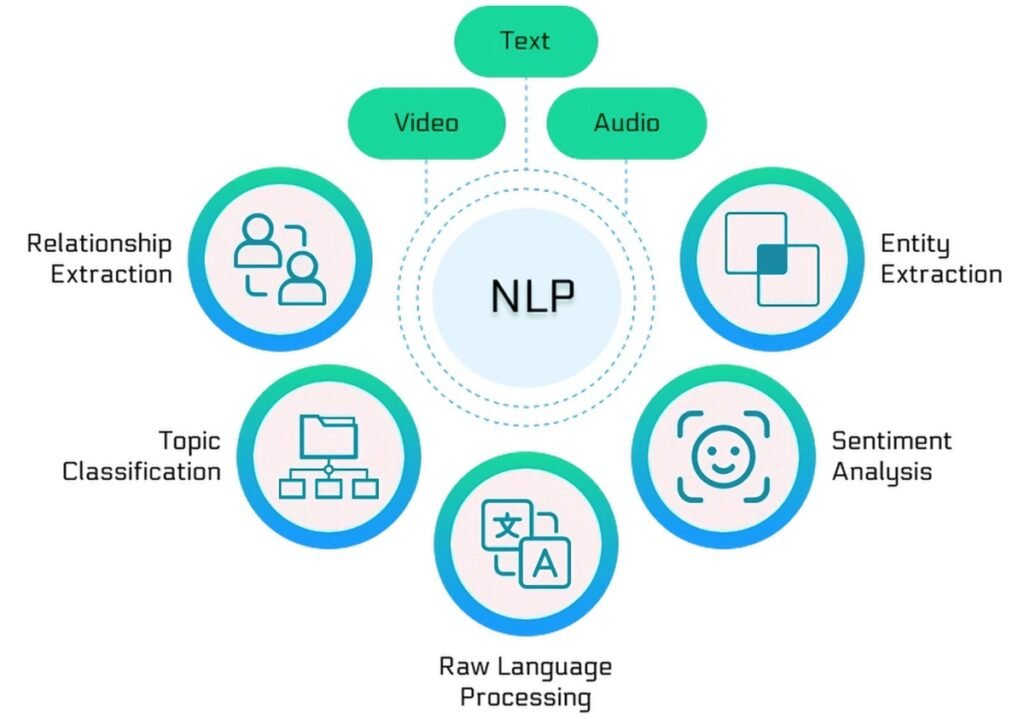
Search engines rely on several NLP-driven processes to deliver relevant results. Understanding how these processes work can help businesses optimize their websites more effectively.
1. Semantic Search
Semantic search goes beyond the traditional keyword search by focusing on the meaning behind a query. It uses contextual keywords and Latent Semantic Indexing (LSI) to analyze the relationships between words. For example, if a user searches for “best Apple phones,” Google understands that “Apple” refers to the company, not the fruit, due to context.
2. Named Entity Recognition (NER)
Named Entity Recognition (NER) is another crucial NLP process that allows search engines to identify and categorize entities within a query. These entities can include people, places, organizations, or even dates. NER helps search engines understand queries like “Apple headquarters location” by recognizing that “Apple” is a company and “headquarters” is a place.
3. BERT and Contextual Understanding
As mentioned earlier, BERT has transformed how Google processes complex queries. Unlike earlier models, which processed words in a linear fashion, BERT analyzes words in the context of the whole sentence. This allows it to handle more nuanced queries, such as those involving prepositions. For example, the query “2019 brazil traveler to usa need a visa” is complex because of the context implied by “to” and “need.” BERT helps Google understand that the user is asking whether a Brazilian traveler to the USA needs a visa.
Steps to Optimize a Website for NLP
To stay competitive in the evolving SEO landscape, you need to optimize your website for NLP. Here’s how:
1. Improve Content for Semantic Search
Instead of focusing solely on primary keywords, content creators should aim to optimize for semantic relevance. This means:
- Using LSI keywords, which are words or phrases closely related to your target keyword. These help search engines understand the context of your content.
- Ensuring that your content covers a topic in-depth, as search engines reward topical authority by ranking websites that provide comprehensive answers.
2. Optimize for NLP Components (Syntax, Semantics, and Discourse)
Search engines now evaluate content based on its grammatical structure and readability. To optimize for this:
- Ensure your content follows proper syntax rules by using clear sentence structures and coherent paragraphs.
- Use semantic-rich language, ensuring that your words convey clear meanings. Avoid ambiguous terms unless the context is well defined.
- Focus on discourse by connecting ideas logically throughout your content. This not only improves readability but also increases the likelihood of your content being featured in snippets and other valuable SERP features.
3. Structured Data and Schema Markup
Implementing structured data via schema markup helps search engines better understand and categorize your content. By using structured data, you can:
- Improve your chances of appearing in rich snippets, knowledge panels, and other SERP features.
- Make your content more accessible to voice search queries, which often rely on schema markup for better comprehension.
Here is the second half of the blog post on Natural Language Processing (NLP) and SEO:
Using NLP for Different Types of SEO
Natural Language Processing plays a vital role across various aspects of SEO. The more NLP optimized is your website, the better result you are going to have in the future. By understanding how to leverage NLP effectively, you can enhance your on-page, technical, and even voice search optimization strategies. Here’s how NLP can be applied to different SEO areas:
1. On-Page SEO
On-page SEO is all about optimizing the content on your website to ensure it’s relevant and accessible to search engines and users. NLP can help refine your approach in several ways:
- Keyword Variants and Semantic Search: NLP algorithms look beyond exact-match keywords and focus on contextual relevance. This means that content should use LSI keywords, synonyms, and related terms to signal to search engines that your page covers the topic comprehensively.
- Entity Recognition: Search engines now recognize specific entities (e.g., people, places, companies) within your content. Incorporating Named Entity Recognition (NER) enables your website to clearly identify and categorize the important entities relevant to your industry. For instance, mentioning “Google” as a search engine versus a location helps NLP models classify the information correctly.
- Featured Snippets: NLP models help Google pull concise, well-structured answers from web pages to display in Featured Snippets. To optimize for these, format your content with clear question-and-answer sections and use semantic-rich language to provide direct answers.
2. Technical SEO
Technical SEO ensures that search engines can crawl, index, and understand your site’s content effectively. NLP impacts this by improving how search engines understand the structure and meaning of your content.
- Core Web Vitals: NLP relies on technical optimizations like Core Web Vitals (e.g., loading speed, interactivity, and visual stability) to ensure that users have a smooth experience. Optimizing for these performance metrics ensures that both search engines and users can easily process your content.
- Structured Data and Schema Markup: By implementing structured data using schema markup, you can help search engines interpret your content more accurately. Structured data allows search engines to categorize your content, increasing the likelihood of earning rich snippets or knowledge panels. This is especially valuable for e-commerce, service-based businesses, and local SEO.
3. Voice Search Optimization
Voice search is rapidly gaining popularity, and NLP is at the heart of how search engines interpret voice queries. Voice searches tend to be longer, more conversational, and often context-based. Here’s how you can optimize for voice search:
- Focus on Conversational Queries: Voice searches are typically structured as questions. You should optimize your content by creating FAQ sections that use natural language to answer common queries.
- Long-Tail Keywords: Since voice search users tend to ask specific questions, incorporating long-tail keywords that mimic natural speech can significantly improve your rankings for voice searches.
- Local SEO for Voice Search: Many voice searches are local-based, such as “best pizza place near me.” Optimizing your Google Business Profile and using local-specific keywords in a conversational tone will help capture these local voice searches.
How to Track SEO Performance with NLP Metrics
As you implement NLP optimizations, tracking the right metrics will help you understand their effectiveness and adjust strategies accordingly. Here are some key performance indicators (KPIs) and tools you should use:
1. User Interaction Metrics
Search engines rely on user interaction signals like dwell time, bounce rate, and click-through rate (CTR) to gauge the relevance and quality of your content. A positive user experience; measured through these metrics; will result in higher rankings:
- Dwell Time: The longer users stay on your site, the more engaging and relevant your content is perceived to be.
- Bounce Rate: A lower bounce rate signals that users are finding what they need on your site and are exploring further, which search engines interpret as a good user experience.
2. Keyword Rankings and Search Intent
As search engines become better at understanding user intent, tracking how well your site ranks for intent-driven queries is crucial. Tools like Ahrefs and SEMrush allow you to monitor your keyword performance and identify opportunities where you can improve your content to better meet user intent.
3. Core Web Vitals Performance
Since Core Web Vitals are increasingly being used as a ranking factor, it’s essential to track these metrics through Google Search Console or tools like PageSpeed Insights. Optimizing for faster loading speeds, better interactivity, and stable visual content will not only improve your rankings but also enhance user satisfaction.
Conclusion and Key Takeaways
Natural Language Processing (NLP) has become an indispensable tool in SEO. As search engines shift toward understanding user intent, context, and meaning, businesses must adapt their strategies to stay competitive. Here are the key takeaways from this guide:
- NLP is crucial for modern SEO: Google’s algorithms, such as BERT, rely heavily on NLP to interpret queries and deliver relevant results.
- Semantic search and entity recognition: Ensure your content is rich in context and addresses related topics comprehensively using LSI keywords and structured data.
- Optimize for voice search: Voice search is growing, and NLP helps search engines understand conversational queries, so optimizing for long-tail keywords and local SEO is essential.
- Track your performance: Keep an eye on user interaction metrics, Core Web Vitals, and intent-based keyword rankings to gauge the success of your NLP optimizations.
By embracing NLP in your SEO strategy, you can ensure that your content not only ranks well but also provides value to users, meeting their needs as search keeps changing.
Frequently Asked Questions
How does NLP affect my SEO strategy?
NLP enhances search engines’ ability to understand context, meaning, and user intent, which requires businesses to focus on creating more comprehensive and semantically relevant content.
What is the BERT algorithm in SEO?
BERT is an NLP model that helps Google understand the context of words in a query, allowing it to deliver more accurate and relevant results for complex search terms.
How can I optimize my website for voice search?
Focus on conversational keywords, create FAQ sections that mimic natural language, and optimize for local searches, which are common in voice queries.
What tools can help with NLP optimization?
Tools like Ahrefs, SEMrush, Google Search Console, and PageSpeed Insights are essential for monitoring performance, optimizing for keywords, and tracking user interaction metrics.
Is schema markup important for NLP?
Yes, structured data through schema markup helps search engines understand your content better, increasing the likelihood of being featured in rich snippets and other SERP features
Written by Saifur Rifat, Founder & SEO Lead at SERP Squad.